Monday, October 11, 2010

Appreciating Arezzo


My first visit to Arezzo was with a colleague of mine at Castello di Casole a few summers ago. The town was only an hour and a half away and neither of us had ever been, so we grabbed a guidebook, jumped in her convertible and headed east. Upon arriving we walked around the city center, poked our heads into a few churches and shops and admired the main piazza. Then we had a nice lunch and left. It was a pleasant enough experience but I wasn’t feeling the urge to return anytime soon.

Fortunately, my dear friend Daniela is from Arezzo and after several trips there with her over the past year I now have a whole new appreciation for it. We always stay at her parents’ house where she grew up which is a real treat for me, especially when I am feeling homesick. Her mother, Giuliana, dotes all over me and she even hems my pants. She is an excellent cook (are there any Italian mothers who aren’t?!), and she looks visibly crestfallen every time Daniela and I go out for lunch or dinner during our visits. As for Daniela’s father, Pietro, you name it, he can fix it. Last time he welded the handle back onto a sterling silver purse a friend got for me in Thailand. Another time he washed my Ford Focus wagon, which is always caked in inches of dust, and buffed it to a sparkling shine with a hand towel.  

Last month, on the first Sunday in September, Daniela invited me to join her for the Giostra del Saracino, a spirited medieval jousting festival that has been entertaining crowds in Arezzo since the mid 1500s.  The Fiera Antiquaria, an antique fair of more than 500 vendors that descend upon the Piazza Grande the first weekend of every month, was happening as well so it was an ideal weekend to visit.

On Sunday morning, in order to be sure we could park, we rode into the city centre on her father’s motorbike. We thought we looked pretty hot in our little dresses and helmets until we saw this photo ...


Daniela has to start and end each day in Arezzo with a stop at Coffee O’Clock (on the main shopping street called Corso Italia), one of the most interesting and inviting cafes in Tuscany. You can plug into its wireless Internet, view the abstract art on exhibit and catch up on the latest news in the International Herald Tribune. The owner Massimo has a booming coffee roasting business and distributes his beans all over Italy and the café has an unusually wide and creative selection of coffee drinks. 


My favorite is the Espresso Shakerato- a martini-style espresso, shaken not stirred, and poured into a thick glass made of solid ice. Catering to its international clientele, there is also a nice selection of infused and loose leaf teas which are almost impossible to find in Italy. That morning I opted for the memory-enhancing blend of yerba mate, orange rind, ginseng, cinnamon, cloves, pepper and rose to be extra sure I would remember the exciting events of the day.

After fueling up we did some window-shopping along Corso Italia, which has several stylish high-end boutiques- L’Albero for shoes and handbags and Sugar with the latest apparel from Prada, Dolce & Gabbana and other Italian designers. Along the way we ran into Daniela’s friend Roberto, the owner of Viaggiando, an upscale sporting goods store right out of Boulder, Colorado. Roberto is an avid outdoorsman who leads hiking expeditions all over the world and upstairs his guidebook and map-reading room beckons adventure seekers with an inviting, weathered brown leather chair.


Continuing up Corso Italia, we ventured into Arezzo’s largest and most beautiful church – the 12th-century Santa Maria della Pieve. Inside and definitely worth seeing is the famous gilded Virgin with Child and Saints painted by Pietro Lorenzetti in 1320, and the glimmering gold and silver bejeweled bust of San Donato, patron saint of Arezzo. Above, the wooden beams are adorned with the Stemma- the white horse symbol of Arezzo. Even more stunning is the church’s crumbling exterior with its striking square tower and its exquisite rounded and columned backside that faces the Piazza Grande.

In the Piazza Grande, where the famous antique fair, the Festa Antiquaria, is held the first Sunday of every month, colorful coats of arms decorating the facades of the buildings and the dark wooden balconies set this piazza apart from all others in Tuscany. 

We crossed the piazza and walked under the famous Loggia del Vasari designed by Giorgio Vasari. After the second restaurant on the right there is a hidden staircase that leads up to the Passeggio del Prato, a lovely, English-style park with lots of shady trees and panoramic views of the valleys below. Since on that particular day the Piazza Grande was being set up for the jousting festival, the vendors at the Fiera Antiquaria were sprawled all over the park displaying their wares. We wandered around the fair for awhile and it really is quite impressive, but you can only look at so many armoires and pocket watches... 

At the top of the park is Arezzo’s lurking sandstone Cathedral of San Donato. Inside the Duomo’s famous 16th-century stained glass windows and under its vibrantly-colored ceiling lie two tombs worth taking a look at- one houses the remains of Pope Gregory X, record holder for pope who took the longest to be elected by his fellow cardinals (three years). The other tomb of Bishop Guido Tarlati, which some believe was designed by Giotto, is decorated with reliefs depicting stories of his life and one featuring a miniature theatre. Next to this tomb is a famous fresco by Piero della Francesca of Mary Magdalene holding a crystal pot of ointment.

Back outside, we headed left out of the church and down via Cesalpino, stopping at Galleria Cesalpino, a cooperative featuring local products from the province of Arezzo, including the extra-warm, nubbed wool jackets, ponchos, handbags and hats from the Casentino (a mountainous region between Florence and Siena) in bold, cheerful colors.
Just up ahead in its own piazza on the right we entered the most important church in Arezzo- the Basilica of San Francesco. It was inside this simple Franciscan edifice in the 1450s in honor of a treasured wooden crucifix by Cimabue that early Renaissance master Piero della Francesca was commissioned to paint The Legend of the True Cross (based on stories of how the timber relics of the cross on which Jesus was crucified came to exist and how the cross helped the Christians win battles after his death).


Happily, it was lunchtime, which is always a highlight for Daniela and me. After briefly contemplating trying something new, once again we ended up at our favorite spot for a mid-day meal, La Formagierra, which specializes in gourmet cheeses from Italy and France. I happen to love cheese more than any other food on the planet so this place, tucked in an alley between Corso Italia and Via Cesalpino, is pure heaven for me. Depending on how decadent I feel, I either go with the mixed greens with fresh and aged sheep and goat’s milk cheeses, or I forgo the greens entirely and sink into the heaping platter of hard and soft cheeses served with a basket of fresh-baked bread. The last time I was there Daniela, who sadly for me does not eat cheese, ordered what looked like pulled pork with white beans and relished every bite.

Now it was time for the procession of the Giostra del Saracino, the famous contest which reenacts the jousts between the Crusaders and the Moors from Africa in the Middle Ages. Throngs of Aretines were lined up and down the streets cheering on representatives from their four neighborhoods proudly marching in medieval garb and leading the knights on horseback up to the Piazza Grande for the big competition. 
I happen to have a bit of a problem with crowds and long parades are a form of torture for me. However I must say that the flag-bearers of Arezzo, which are among the most famous in the world, were incredible.
Daniela and I didn’t have tickets to watch the tournament in the stands, thank god, so we gathered around a television outside a bar to watch the spectacle in the piazza. You would think that the knights would be racing towards one other trying to knock each other off their horses, right?   

Not so. Basically there is a dirt path of a few hundred yards and on the far end is an oversized Moorish man made of black metal holding a sort of bulls-eye. There are two knights for each neighborhood, and one at a time the knights race at high speed with their long, smudge-tipped lance pointed directly at the bulls-eye. Depending on where the lance hits they are awarded points, and if the lance breaks they get double points. This year the neighborhood from the city centre, which none of the other neighborhoods particularly like, beat the underdog when the knight broke his lance. 

After the rather raucous crowd in front of the television eventually dispersed, Daniela and I decided it was time for an apperitivo at Terra di Peiro in Piazza San Francesco.  This quaint little enoteca has an impressive list of wines by the glass and delicious snacks. We sat at a little table outside watching (depending on which neighborhood they were from) the gleeful or dejected faces of the passers-by.

With a bit of time to kill before dinner and knowing how much I love to shop, especially when a good deal is involved, Daniela brought me to a fabulous women's clothing boutique close to the train station on Via Niccolo Arentino called G-Loft. The owner, Giulio, has an eye for elegant, fashionable, one-of-a-kind pieces. He carries only Italian designers and the prices range from moderate to high. I was pleasantly surprised to find several special pieces still on the sale rack from July.

For dinner that night, Daniela chose Saffron, a Japanese trattoria serving sushi, sashimi and “international creative” cuisine.  Opened in 2004 by a young woman from Arezzo who was attracted to the Japanese mentality and worked at a sushi restaurant in Florence, Saffron is a welcome break from the bruschetta, pasta, and wild boar dominating the menus in Tuscany. As I eagerly blended my soy sauce and wasabi, preparing for my first bite of raw tuna in six months and taking occasional sips from my glass of cold sake, Daniela whipped up her own concoction of olive oil and Balsamic vinegar into which she dipped each piece of raw fish followed by a taste of Chardonnay. I winced at the travesty but let it pass. Arguing over what constitutes “good food” with an Italian is one battle that will never be won.

Daniela, who happens to love the desserts at Saffron, was visibly dismayed when I told her I wasn’t in the mood for “dolce.” But I didn’t need any more sugar. Our day in Arezzo had already been filled with plenty of sweetness.

Saturday, August 21, 2010

Digging Deeper in Volterra

Owners and guests at Castello di Casole often ask me which towns in Tuscany they should visit, and whenever they do, I recommend Volterra. One of my favorite places in all of Italy, Volterra has a good thousand years on the other Medieval towns in the area and there is so much to see that very time I visit I discover something new. The approach to this magnificent monolith, rising starkly from a high hilltop at the summit of a sharply winding road, is stunning. The city centre is easy to navigate, parking is a breeze, and it is mercifully free of the throngs of tourists crowding the streets of neighboring San Gimignano.


After several visits, I had wanted to dig deeper into the soul of Volterra, and I needed to write an article about the town for The Florentine, a newspaper for English speakers in Tuscany. So I was thrilled when my colleague Raffaella introduced me to Lisa Halderman, a fascinating American woman who lives in San Gimignano and leads walking and hiking tours with Wilderness Travel.  I recently had the pleasure of spending a day in Volterra with Lisa who generously shared her knowledge of the history and local lore.

Before we began our tour Lisa gave me a little background on the Etruscans - those ingenious, indulgent, superstitious metalworking masters who chose Volterra as the site for their biggest outpost back in 800BC. No one knows where the Etruscans came from and their language as not yet been cracked by scholars. All we know about these people is what has been found in their tombs, which are located in pockets all over Tuscany, many still undiscovered.

We started our adventure from the parking area at Porta Docciola, which is free and always has plenty of spaces (see below for directions). From the medieval gate there are two sets of stone stairs that ascend to the city centre- we took the steps to the right into Piazza San Michele. (Directly across from the San Michele church, Enoteca Scali has an impressive selection of wines from the region). Then we headed up Via Matteotti, the main shopping street of Volterra and a popular spot for the evening “passeggiata” (stroll), for a cappuccino at L’Incontro. A favorite bar among the locals, elegant L‘Incontro serves homemade gelato in the summertime and in winter handmade chocolates formed into little sarcophagi.


 We bypassed the Duomo and all of the main sights I had already seen several times and stopped at the Tourist Office in the Piazza de Priori to pick up a map of the town. On the way Lisa pointed out the local sandstone called “panchina” used in the buildings and pavement around town. When I looked down at the gritty grey stones under my feet, right there staring up at me was the perfectly preserved fossil of an ancient seashell.

Since I was interested in learning more about the history and art of alabaster sculpting, our first stop was the Alabaster Cooperative in the piazza, which showcases the talent and range of local sculptors and is definitely worth a visit. I learned from Lisa that alabaster is so soft it can be carved with woodworking tools, and since it is water-permeable, it is used purely for decorative purposes.

Lisa then took me to two shops that represent the two extremes of modern-day alabaster sculpting. The first, Opus Arts, in Piazza Minucci across from the alabaster museum, features the work of Giorgio Pecchioni, a next-generation sculptor who is not only keeping the ancient art form alive but pushing it to new extremes with his life-sized electric guitar and a complete drum set. (Later that day Lisa brought me to Giorgio’s studio, where the artist was at work, sporting his signature newsprint cap, his tools, the floor and his body blanketed in inches of white powder).


Through the arch to the left and in sharp contrast to Opus Arts, the Rossi family has been sculpting classical alabaster works at Rossi Alabastri since 1912. Walking into this gallery is like entering a museum, its shelves lined with exquisitely carved urns, vases, bowls and other decorative pieces. We peeked into the studio to the right of the shop and there was a member of the Rossi family sawing into a piece of stone before a captivated crowd.


Lisa wanted me to see the reproductions of Etruscan gold jewelry at Fabula Etrusca on the way to the Roman amphitheatre so we stopped in for a look. During my first visit to Etruscan museum in Volterra several years ago, I remember being awestruck by intricacy and minutia of these exquisite gold artifacts. To think that the Etruscans were capable of crafting such exquisite, finely detailed necklaces, bracelets, earrings and cloak pins over two thousand years ago without the aid of magnifying glasses is truly astonishing.

I was immediately captivated by the reproductions at Fabula Etrsca and was thrilled to be invited into the studio next to the ship to see first-hand how the intricate gold pieces are created using modern-day tools and techniques. I inquired about a particular pendant that caught my eye and learned that it is a reproduction of an Etruscan flask found in a tomb discovered just three years ago on the outskirts of town.


Lisa guided a reluctant me out of the shop and we continued further down the street to the Roman amphitheater and baths that date back to the first century. We were able to view the partially recreated site perfectly from this vista. Lisa told me that the amphitheater functioned as the town dump for centuries until an archeologist discovered ruins underneath and patients from the insane asylum in town were enlisted to dig out the trash.


The panoramic views stretch to the Tyrrhenian Sea and on a clear day you can see all the way to the Cinque Terre. The San Giusto Clemente church off to the left was built in the 1600s in honor of two brothers- Saint Giusto and Saint Clement. Legend has it that during a particularly savage barbarian raid, the brothers persuaded the Volterrans to throw bread over the walls to their enemies, fooling them into believing they had enough food to last for months. The disheartened barbarians retreated and the town was spared.

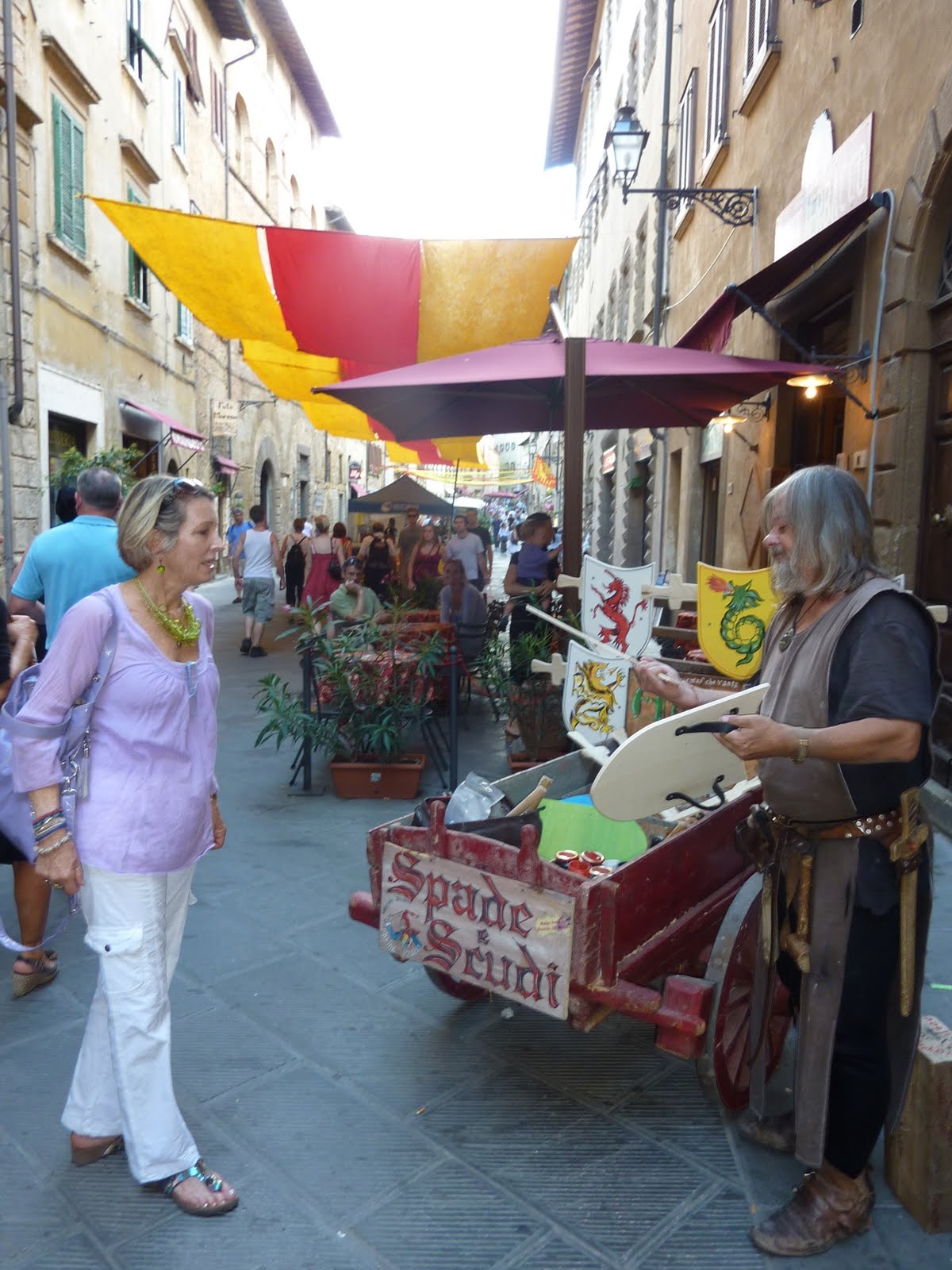
At the end of the street we headed right and circled back through Piazza San Michele and on to Via Gramsci. As we strolled down this pleasantly wide shopping street leading to the Guarnacci Museum, which houses the largest private collection of Etruscan artifacts in Italy, we stopped to chat with a colorful coat-of-arms artist who looked like he stepped right out of a Renaissance painting. 


We stopped by a delightfully aromatic coffee roastery and visited the shop of weaver who was sitting at her loom forming fine strands of wool, mohair and cashmere into a brightly colored scarf when we arrived. We couldn’t help but admire Anna Maria’s wonderful selection of one-of-a-kind sweaters, scarves, blankets and hats all lovingly handmade.


I didn’t have time to visit the Guarnacci Museum, where I seem to always end up on the top floor admiring the gold collection, so during lunch I asked Lisa for an update. She said that the most exciting new addition is a helmet found alongside that flask found in the tomb I mentioned earlier. She also told me about the “lacromato”, tiny vases in the vase collection which were used to collect tears at funerals. Perhaps the most famous Etruscan artifact is the tall, dark and skinny Ombra della Sera, “the Shadow of the Evening” which you will see reproductions of in shops all over town.

Speaking of lunch, we were both quite hungry after a morning of intense sight-seeing so I asked Lisa to take me to a place that locals love and tourists would be hard-pressed to know about. She certainly delivered with Trattoria da Badò. Located on Borgo San Lazzero, the main road into town across from the COOP, da Badò is know for its simple, extremely fresh, seasonal Tuscan menu. 


Lisa, whose visits are an obvious pleasure for the attractive male wait staff, started us off with a wonderful surprise that was not on the menu- “cipolle frite,” sweet red onions deep-fried in tempura batter. I had not had onions rings in over a year and a half and I went to town on those sweet, crispy morsels, calories be damned. 

Next up for me was the fried baccalà, a surprisingly tender white fish served piping hot under a hearty tomato sauce with a side of chick peas. Lisa opted for the tortelloni with ricotta and spinach in a veined pecorino sauce and we were both sad when the last bite was gone. We didn’t have time or room for the second course but judging from the smiles on the faces of our neighboring diners, the grilled meats are cooked to perfection.

Had I not had to rush back to Florence, I would have taken a walk through the lovely gardens in the Parco Arceologico situated below the massive Fortezza Medicea, an operating prison since the 1400s where many a Mafioso has done time behind bars. But being the working girls we are, Lisa and I had other responsibilities to tend to so we said our goodbyes and agreed to make plans for a future adventure together. 

Before heading back to Florence, I had to make one final stop. There was simply no way I was leaving Volterra without it....


Getting there: Take the Firenze-Siena highway towards to the Colle Val d’Elsa Nord exit and follow signs west to Volterra another 20 kilometers. The best place to park is the lot at Porta Dioccola. As you approach the town, pass under an arch and look for a COOP grocery market on your right. Take the next right and follow the tree-lined street along a stone wall, bearing left at the first intersection. A large dirt parking lot will be on your right.

Monday, July 12, 2010

Beach Baby, Beach Baby

Summer arrived late in Tuscany this year after an unseasonably cool and rainy June. And when it finally arrived, it came with a vengeance. July has been roasting hot in Florence so far and the only real way for me to get some relief is to head to the countryside where I work selling the most beautiful farmhomes in all of Tuscany at Castello di Casole, or hit the beach. So in order to stay cool this summer I have made it my personal mission to frequent as many beaches as possible on my days off.  Here is a little introduction to two very different stretches of sand I recently discovered.


VIAREGGIO
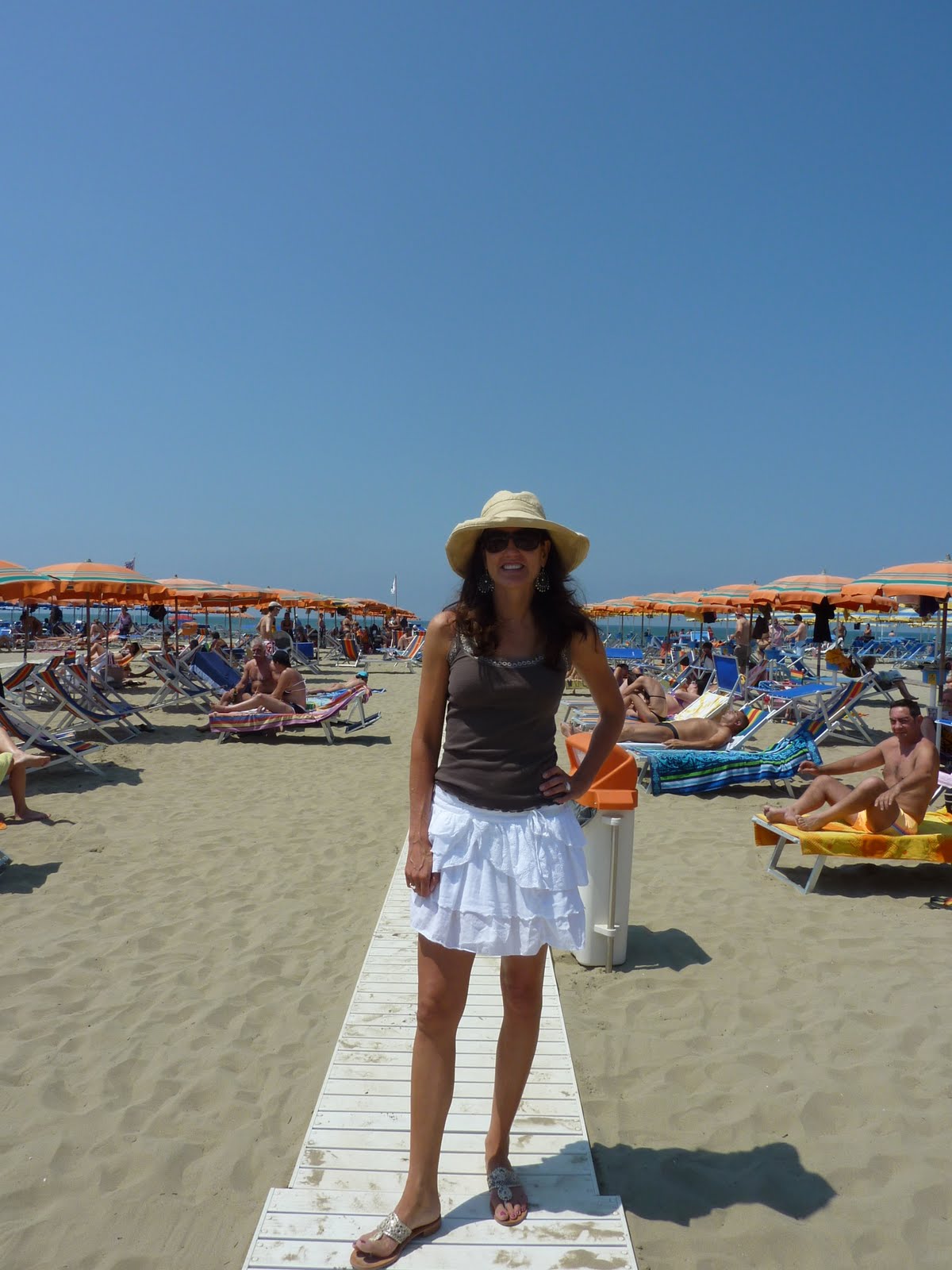
One Saturday in early July Daniela and I decided to drive to Viareggio, a bustling urban beach town only an hour by car from Florence and an hour and a half by train. Viareggio is home of the famous carnival of Viareggio which dates back to 1873 with its paper-mache floats that parade along the Promenade of shops and cafes that parallels the shoreline in the weeks preceding Easter. It being a weekend I was expecting to encounter hoards of people but I was pleasantly surprised at how easy it was to find a parking space. The beach was certainly active and lots of people were walking along the water’s edge, but it was nothing compared to beach in Riccione on the Adriatic Sea which I will write about in another story…

What I really like about Viareggio, and what distinguishes it from its more upscale counterpart, Forte dei Marmi just fifteen kilometers up the coast, is the way the beach resorts or “bagnos” that line the beach are situated right behind the shops and cafes along the Promenade in the center of town.  Each bagno has its own sets of cabanas, rows of lounge chairs and brightly colored umbrellas, a little bar and a restaurant as well.
A day at a bagno in Viareggio costs anywhere from 15 to 30 euro, and you can pay by the day or month, or like many Italian families do, the whole summer. Some of the bagnos even have swimming pools. The key is to get chairs as close to the sea as possible where the breeze is the strongest. In order to do so, you need to arrive early or even call a bagno to reserve your space ahead of time. Food always being a priority for me and Daniela, we walked past bagno after bagno until our stomachs stopped us in front of a little café on the beach at Bagno Guido. 
After a light salad with tuna and mozzarella, we parked ourselves on two lounge chairs and relaxed in the sun all afternoon. Then we walked along the beach, which stretches for miles in either direction, to the next little resort town, Camaiore, and ventured down its long white pier that stretches out into the sea like the prow of a big ship.

Back at the bagno Daniela took a little nap while I did some yoga under the shade of our umbrella. At the end of the day we threw on our beach cover-ups and took a stroll along the Promenade. Noticing that the July sales were in full swing, we couldn't resist poking our heads into a few shops along the way. I found a great summer dress by one of my favorite Italian designers, Massimo Rebecchi  (you can never have enough dresses in Florence) and Daniela bought some blue Tom Ford sunglasses that she was particularly excited about and which happen to look fantastic on her.

Due to its proximity to Florence, its accessibility and its lively combination of beach, shops and cafes, Viareggio is an ideal place to spend a hot summer day, especially for families with kids. My advice is to scout out the bagnos right behind the shops in the city center for one that feels the most appealing and has the most desirable lounge chair/umbrella location. Those seeking a more luxurious beach experience might want to check out the new bagno “Teresita" which costs around 100-120 euro for the day.  

To get to Viareggio, take the A11 west to Lucca where there is an exit for Viareggio then head north on the toll road until you arrive at the exit for Viareggio. Drive into the center towards the beach and make a left turn at the T-stop. You will see several parking areas on your right as you approach the city center.

PARCO DELL'UCCELLINA

On another steamy summer day, my friend Paolo invited me to spend an afternoon with him at Parco dell’Uccellina, a national park that runs along a six kilometer stretch of the Maremma coast south of Grosetto. The drive to Parco dell’Uccellina from Florence is about two hours, maybe even two and a half, but it’s worth every minute. The polar opposite of Viareggio, the park is wild, rich with natural beauty and there is not a bagno in sight. The sand is fine, the sea is cool and inviting, and there are little huts made of driftwood scattered along the beach where you can find relief from the mid-day sun. 


Since it was Sunday, otherwise knows as the worst possible day of the week to go to any beach in Italy given the traffic and the crowds, we decided to arrive in the afternoon. 3PM was late enough that we only waited ten minutes in the queue to park the car in the lot adjacent to the beach. Once inside we stopped to fuel up at the park’s bar and restaurant. After sliding into a parking space just steps from the beach, we headed south for about 15 minutes to a surprisingly secluded spot.


According to Paolo, the land that comprises Parco dell'Uccellina was once malaria-infested marshland. Then under Mussolini’s “bonificare” system in the 1930s the marshes were filled in with dirt for agricultural purposes. Now there are farms and horse and cattle ranches all over the area. The cattle ranches are home to the famous “Vacca Maremmana,” the white cows which Paolo says taste even better than the Tuscan Chianina because the cows are outside all day walking around and eating the special grasses that grow by the sea.
I was fascinated to learn from Paolo that there are cowboys in the Maremma called “butteri” who in the olden days used to wear velvet jackets and black hats while tending the cattle and sheep. Legend has it that Buffalo Bill and his circus came to the Maremma in the 1800s and challenged the butteri to a rodeo and guess who won??? According to Wikipedia, there are only five or six large herds still tended by butteri in the park today, however the tradition of the butteri lives on outside the park in small demonstrations in the region's rural towns and in the Italian equivalent of rodeos.
Thoroughly enjoying our secluded spot on the beach, Paolo and I talked, (or rather he spoke in Italian and I pretended to understand), read our books and took occasional dips in the refreshingly cool sea until dusk. The last hour or so was the best hour of the day because we were the only ones left on the beach. As we left the park the sun was shining brightly while a gentle rain began to fall and when we looked out the window to savor that magical moment, here is the sight that greeted our disbelieving eyes. Talk about a grande finale...
Fortunately Paolo had made a dinner reservation at Da Remo, a very special restaurant in Rispescia just five minutes from Parco Uccellina, Da Remo is famous all over Italy and it is virtually impossible to get a table in July and August without making a reservation well in advance. Remo opened the restaurant 19 years ago and he serves only fresh fish from the Maremma coast at very reasonable prices. 


We started with a mixed seafood antipasti featuring five different fish and shellfish, then we shared a tender white fish called corvina cooked Maremma-stye in foil with tomatoes, parsley, clams, mussels and juniper berries from bushes in the sand dunes all along the coastline. The waiter, who spent a good ten minutes perfectly fileting our fish tableside, recommended an unusual and unusually good Maremma white wine made from the French Voignier grape. I ate every morsel on my plate and drank every drop in my glass and proceeded to pass out for most of car ride home. Thank god Paolo was driving…

Parco dell’Uccellina is one of Tuscany’s many hidden treasures. I would highly recommend spending a day, or even two, at the beach as long as you bring an umbrella or get there early enough to claim one of the driftwood huts. There are many reasonably-priced agriturismos (bed and breakfasts on working farms) in the area or you could experience one of the most luxurious hotels in all of Italy at Il Pelicano in Porto Ercole a bit further south down the coast.

To get to Parco dell’Uccellina, drive south on the Firenze-Siena highway and head in the direction of Grossetto when the highway ends after about sixty kilometers. Pass Grossetto and continue for about 20 kilometers to the Rispescia exit. Turn right and you will see signs for the parking area up ahead on the left. 

Wednesday, March 24, 2010

The Dolomites: A Skier's Paradise


When I was 17, my parents sent me off for a week of skiing in Chamonix, France, with a group from my high school in Connecticut. It was my first trip to Europe and it was a life-changing experience for me. My favorite part was the day we skied into Italy. Something deep inside of me really connected with the place in a way I had never experienced before. It felt like coming home, and I am sure it is a big part of the reason why I call Italy home today.  I have always wanted to relive that experience and finally last week the opportunity arose when my friend Marco invited me to join him for four days in the Dolomites.

The drive from Florence to the vast, stunning mountain range comprising the Dolomites, a UNESCO World-Heritage site in the Alps that forms a border between Italy, Austrian and Germany, normally takes about five hours. However, Marco, being a bit of a lead foot, made it to the Val Gardena, which he says has the best skiing in all of Europe, in just over four hours. He had booked an all-inclusive, three-night stay at Hotel Diamant, a lovely little lodge with an impressive wellness area between the charming alpine towns of Ortisei and Santa Cristina.

After we checked into our room with a balcony framing a postcard-perfect rock formation called Sassolunga, we drove a few kilometers to Ortisei where we rented skis and poles at Carlo’s ski shop. Back at the hotel, we immediately changed into our bathing suits and spent the next few hours soaking in the indoor and outdoor whirlpools, steaming in the Turkish Baths (one scented with a soothing blend of eucalyptus and other herbs), and drying off the warm, hot and infrared saunas.


Dinners were included in our hotel package and our meal that night featured a buffet of local cuisine with a wide variety of pork dishes and beef tongue which Marco heartily devoured while I tried not to watch. I opted for the dumplings, a heaping pile of potatoes and the salad bar and we enjoyed a bottle of fruity, light Muller Thurgau from Bolzano, a large town we drove through in the foothills of the Dolomites in the Alto Adige region. Northern Italy, and specifically the Alto Adige, is famous for its white wines and I was particularly excited to sample a few different varietals on this trip.


The next morning the mountains were blanketed in a layer of fog and it was snowing pretty hard so we took our time at the substantial breakfast buffet. Eventually we boarded the hotel shuttle and headed to the gondola in Santa Cristina. As we ascended the mountain, I became increasingly nervous about the lack of visibility and my lack of familiarity with this ski area. Fortunately, Marco, who is an excellent skier, proved to be a very patient and supportive guide. We were enveloped in a shroud of fog and I couldn’t see more than four feet in front of me most of the time, but we did hit a few clear patches with fresh, untouched snow.  Lunch for me and my tired, tense legs came none too soon. We dined at a little chalet on the mountain and I ate another bowl of dumplings as we watched the snow fall out the picture window. Eventually a group of large, boisterous German men drinking massive beers descended on our table so we ventured back out into the fog and blindly worked our way down the mountain. Needless to say, we were relaxing in the whirlpool within minutes of arriving back at the hotel.


The following day we awakened to periwinkle blue skies, warm sunshine and a magnificent view out of our hotel room window. Finally I was able to see the incredible stretch of wild beauty all around me that I had only been able to imagine the day before. The Dolomites are truly awe-inspiring. (According to Wikipedia, the term “dolomite” was coined by a French mineralogist in the 19th century and is a kind of carbonate rock that causes the striking formations and colors of these mountains). 


The Val Gardena area of the Dolomites is huge and I was wide-eyed and speechless as we rode the bus ascended the gondola that morning. Thankfully Marco knows this area well and the snow was hard-packed and very fast so we were able to cover a lot of ground which included passing through an adorable alpine village called Selva. 

We stopped for a hearty lunch of polenta and fontina cheese at the same chalet we dined at the day before, but this time we were able to sit outside, catch some rays and take in the views.
We continued skiing until our legs gave out then headed back to the hotel for a final round of relaxation in the warm waters. 

I have to admit that I was feeling a little melancholy at dinner that night knowing that we would be leaving this beautiful, romantic alpine paradise the next morning. So over glasses of limoncello and grappa we plotted out our next Dolomites adventure, this time in Corvara, Marco’s  favorite town in the Val Gardena, with a side trip to Cortina to check out the legendary après- ski scene.


The weather had turned for the worse the next morning so we opted to go for a walk around Ortisei before driving back to Florence. Painted in pastels and nestled in a valley with the majestic mountains rising above it, Ortisei is a charming village with some nice shops and a few interesting churches. The highlight is the Adler Spa & Resort, which has one of the best-rated spas in the Alps and the “largest and most impressive water world in the Dolomites.” I highly recommend this little gem to those who prefer a more a luxurious, indulgent mountain experience. I, myself, look forward to staying there during a future ski trip to the Dolomites, of which I now know there will be many.

Monday, February 15, 2010

Lunch at Jennifer's: Lesson One - Raw Artichokes


Right now I am sitting in my apartment on a mild winter afternoon enjoying one of my favorite Tuscan winter lunches of all time- a salad of raw carciofi (artichokes) and a heaping pile of white cannellini beans drenched in a delightfully fragrant olive oil a friend gave me- freshly pressed with olives from his family’s estate. (We love friends having friends like this.)

Until I moved to Florence I had never eaten an artichoke that hadn’t been steamed or boiled for at least 45 minutes so I was a little skeptical the first time I tried this salad. In fact, I was pretty sure I would be chewing for the better part of the day, but I was pleasantly surprised at how tender the artichoke slices were and it didn’t take long for me to help myself to seconds.


There are a few secrets to making a really good carciofi salad, one that even Italians will compliment you on. First, you need to find the small purple artichokes from Italy called Morello or Morellino, which a specialty shop like Whole Foods might carry. Next you have to peel off all of the tough outer leaves. Slice off the prickly tops and the stems and cut the chokes in half.

Then- this is the key part- thinly slice the chokes vertically so that a piece of the heart is on the bottom every slice holding the leaves together. Toss the slices in a bowl with some finely chopped Italian parsley, fresh lemon juice and sea salt, and serve with shavings of a nicely aged Parmesean Reggiano.

As for the cannellini beans, soak a cup or two in a big bowl of water overnight. Rinse and put in a large pot with about 2 inches of over the top of the beans. Add a few sprigs of rosemary and bring the beans to a very low boil. Then turn the heat down as low as it will go and simmer the beans until tender, probably 30-45 minutes, making sure not to allow the skins to break. I put a cover on the pot and leave a little crack for the steam to get out so they don’t stand a chance of coming to another boil.

I always like to end my lunches in wintertime with a cup of chamomile tea and a few clementines from Sicily. I picked these up this morning at the open-air martket at Piazza Sant' Ambrogio. Aren't they pretty?

Thursday, February 11, 2010

Sundays with Daniela


My friend Daniela and I have gotten into this really fun routine on those Sundays when I am not working at Castello di Casole… I pick her up at around 9AM and we go to our health club for a workout and a steam in the Turkish bath. Afterwards we head out, on foot or by car, to a place I have never been, and walk around for awhile until our stomachs start rumbling. Then we find a restaurant she has heard about or has personally experienced and knows we will love. We wait for just the right table, order a glass (or when we’re in a particularly festive mood a bottle) of vino, and introduce ourselves to our waiter who, over the course of the next 2-3 hours, inevitably becomes our friend. Then we open our menus like kids on Christmas morning. I always do a quick scan for fish and chicken dishes before conducting a more thorough search of the day’s selection. Though it is irksome to Daniela at times that I don’t eat red meat, she can’t eat wheat and only occasionally indulges in cheese so it sort of evens out.

A few Sundays ago we had planned to take a road trip, but that particularly morning the sky was cobalt blue and the air was pure and crisp (“sano” as Daniela calls is). Florence was bathed in a dazzling golden light and it seemed like a perfect day to be outside. So we decided to walk from my apartment through the San Niccolo neighborhood up to Piazza Michelangelo to take in the views then head back downhill into Oltrarno  (the other side of the Arno) for lunch.


I have been to Piazza Michelangelo a number of times, and each time I reach the summit and turn to face that sea of Renaissance treasures stretching out below me, it takes my breath away. A visit to the piazza is not complete without continuing up the road to the church of San Miniato which is still a functioning Dominican monastery. My favorite spot is the little chapel, built by the Medicis in honor of Jacopo of Portugal who died when he was only 26, with its plush ceiling of blue and white glazed terra cotta panels by Lucca della Robbia.


We had worked up quite an appetite by the time we descended into Oltrarno. We were hoping to get to Olio & Convivium before the lunch crowd arrived only to discover that it was closed. Luckily for us Daniela remembered an enoteca further down Via Santo Spirito called il Santino. When we opened the glass door and entered the warm, cozy room with a tiny bar and only four tables, I knew right away that this is a place I will return to many times in my life. All four tables were full so we stood at the bar and ordered a glass of vino rosso while Filippo, the “oste” as he is called here, prepared a small plate of Pecorino cheeses with a peppery jam. Next up was an order of baccala, a traditional Tuscan salt cod, in this case served as a creamy spread on slices of toasted bread drizzled with fresh olive oil.

Warming on a shelf below the bar were four steaming pots of various soups and stews. We both ordered the white root vegetable puree to start and I followed mine with a savory fish stew while Daniela opted for the polpette, tender small meatballs in a light tomato broth. Well into our second glasses of vino rosso we struck up a conversation with Filippo and a firefighter from Rome sitting next to us at the bar. Before we knew it another hour had passed and, as usual, we closed the place down.

Last Sunday Daniela told me she wanted to take me to a very “special place” in Cortona which she had been talking about for weeks. I was filled with anticipation as we drove an hour or so down the A1 through Arezzo. When we arrived in Cortona we were completely famished so, before heading to the “special place,” we went straight to Osteria del Teatro, an all-time favorite of Daniela’s tucked into a side street near the famous Teatro Signorelli. Seated at a corner table surrounded by cheerful yellow walls adorned with black and white photos of various theatre performances , we settled into a bottle of Achelo, a full-bodied Syrah from Cortona that cost a mere 12 euro.

Lunch for me was a trio of hearty Tuscan soups served in little terra cotta crock pots - pappa al pomodoro (bread and tomatoes), ribolitta (minestrone with bread) and mushroom and farro (a winter wheat-like grain), all served with more bread. Daniela ordered the Scrigno di Chianina- the famous Tuscan Chianina beef cooked in a glass jar in the oven at a very low temperature. As she savored each bite, she kept telling me, as she often does, how much I was missing by not eating red meat. “One of these days,” I assured her. “Piano, piano.” (Slowly, slowly).

Osteria del Teatro is known for its chocolate, so in preparation for dessert we went easy on the second course, ordering a medley of winter vegetables and white beans. When our waiter, Ferruccio, brought out a thick butcher block cutting board with several slabs of velvety light and dark confections, one dotted with nocciola (hazlenuts), I knew I was doomed. It took a good half-hour for us to polish off all of the mouth-watering shavings, some with hints of fruit, cinnamon, and even pepper. We were, once again, the last to leave, but before we said our goodbyes, Daniela made another lunch reservation for us on February 22nd, when Cortona honors Santa Margherita, its patron saint, with a big celebration. (I haven't told her this yet, but this time, if I get my courage up, I might just try a bite of beef or maybe even veal which seems to be the specialty of the house).

Our appetites satiated we were now ready to visit the “special place” Daniela had promised to take me to. As we wound our way down the hill from Cortona she suddenly turned right onto a long, hidden drive through fertile woods that follows the footsteps of St. Francis to Convento delle Celle, a 13th-century monastery believed to be founded by the saint in 1211.

What a gem this place is. Nicknamed “Cappuccini” after the brown robes with hoods worn by Franciscan monks who still live and worship there, the hermitage was built in a gorge carved by a stream that during the wintertime becomes a raging waterfall. After walking around the grounds, we sat and quieted our minds for awhile in the original cell of St. Francis where he made his home in 1226.


There is so much wonderfully soothing energy pulsating through this place, that had we not consumed an entire bottle of red wine and more chocolate than either one of us has eaten in the past year, we might have lingered. But it was getting dark and before heading back to Florence Daniela wanted to show me her home in the countryside near Arezzo which she owned in her 20s. As we walked away from the monastery I glanced to my right and was treated to this magical sight. It's no wonder St. Francis was drawn to this sacred place.


This coming Sunday I am trying to talk Daniela into going to Viareggio, a beach town an hour and a half by train from Florence, to see their Carnivale parade which is supposed to have the most incredible floats. If I stand any chance of success in getting her to join me I will need to find a really incredible restaurant so if you have any recommendations, please send them my way.